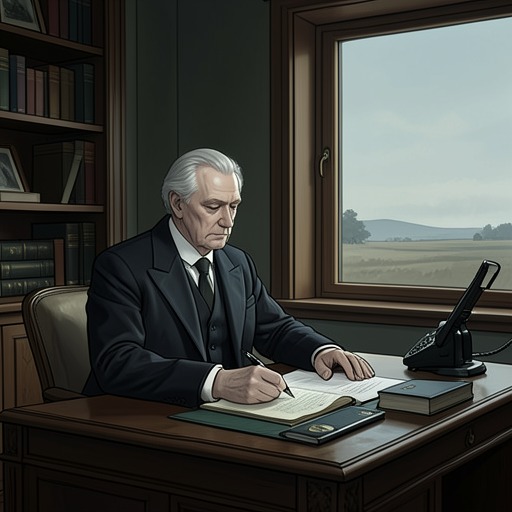
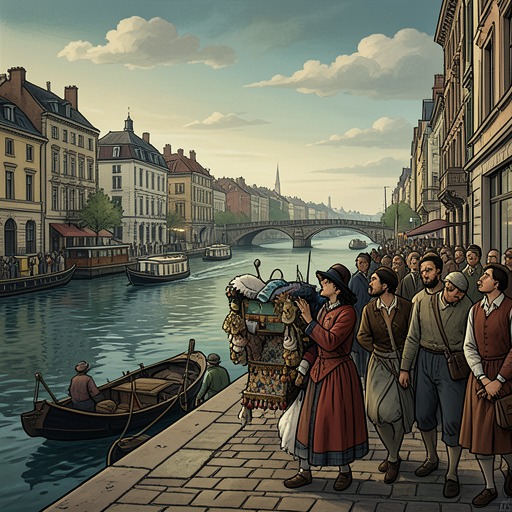
Aschenbach arrives in Venice by boat
Death in VeniceAschenbach arrives in Venice by boat after recognizing that the Adriatic island where he had stopped was not the destination he sought. The passage brings him to the city through its most theatrical entrance, amid images of luxury and death, and delivers him to a seaside hotel whose cosmopolitan guests and beach life begin his encounter with Tadzio. From the outset, arrival is more than a change of place: Venice answers his hunger for the foreign, yet its beauty comes wrapped in unease and a growing disorder the city will try to hide.
The Search for a Destination
Literary and social obligations delay Aschenbach’s departure for about two weeks after his walk in Munich. He arranges for his country house to be ready within a month, takes a night train to Trieste in the middle or latter part of May, stays there for just twenty-four hours, and embarks the next morning for Pola. His itinerary begins as a search for somewhere different from himself but readily reachable, a place that can interrupt his familiar life without demanding a remote journey.
The island he tries does not meet that need. Its rugged cliffs face the open sea, and its inhabitants, in variegated clothing, speak in sounds that strike him as strange. But rain and heavy air, the hotel’s provincial and exclusively Austrian clientele, and the absence of the soft sandy shore he wants all frustrate him. The disturbance that drew him away from home remains unresolved. After a week and a half, he understands that he has lost sight of his real destination: Venice, the city that promises the fabulously different within overnight reach. He gives notice of his mistake and, in early morning mist, takes a fast motorboat with his luggage back to the naval port, where he transfers directly to a ship already under steam for Venice.
Arrival by Sea
The vessel is an old, soot-blackened Italian ship, decrepit and mournful. A dirty, hunchbacked sailor conducts Aschenbach to a cave-like, artificially lit cabin, where a ticket seller with a goatee, a cigarette stump, and the air of an old circus director records his particulars. Aschenbach requests Venice in first class. The seller’s brisk, theatrical routine—his confident praise of the destination, rapid handling of the money, and ceremonious farewell—seems designed to reassure a traveler who might still change his mind. Aschenbach returns to the deck, but the passage has already made arrival feel like a performance staged for him.
The delay before Venice brings another disturbing spectacle. A group of young men from Pola, warmed by Asti and stirred by military bugle calls from near the public gardens, cheer the drilling bersaglieri. Among them is an old man who has tried to disguise himself as a youth. Now painfully drunk, with glazed eyes and trembling fingers, he sways in place, cannot trust himself to take a step, and accosts those nearby with leering gestures and drunken banter. Aschenbach watches darkly. The old man’s grotesque attempt to join the young seems to distort the world around him, an impression interrupted when the engines resume and the ship passes through the San Marco canal.
From the water, Venice appears as a composition made for spectacle: the palace, the Bridge of Sighs, the columns bearing the lion and saint, the ornate flank of the temple, and the giant clock. The approach confirms Aschenbach’s sense that this unreal city should be entered by ship across the sea, not reached by rail as if entering a palace by its back door. The view is magnificent, but it follows the drunken passenger’s unsettling display; the city’s enchantment does not erase the grotesque that has accompanied the journey.
The Gondola Passage
At the landing, customs officers perform their duties perfunctorily, and Aschenbach asks for a gondola to take him and his luggage to the dock for the small steamers serving the Lido. He intends to stay near the sea. While his trunk is dragged down the ladder-like steps, the drunken old man lingers to offer a slurred farewell, addressing Aschenbach as if he were a young man with a sweetheart. His false upper teeth slip down onto his lower lip as Aschenbach escapes down the gangway. The scene repeats the journey’s uneasy collision between age and youth, ceremony and humiliation.
The gondola initially seems to offer a quieter passage. Its unchanged, old-fashioned form and coffin-black finish suggest a bier and a final journey, yet the seat is exceptionally soft and luxurious. Aschenbach reclines opposite his neatly arranged luggage while the gondoliers quarrel in harsh, incomprehensible voices. The city’s silence seems to disperse their argument over the water. In the warmth of the sirocco, he closes his eyes, enjoys a languor unusual for him, and wishes the short trip might continue forever. The wish to surrender to the ride is countered by the image of death embedded in the craft itself.
The gondola glides away from the crowd, but Aschenbach soon notices that the lagoon is widening and that the boat is heading toward the open sea rather than the steamer dock. He turns to the gondolier and repeats his destination. The rower, a forceful and unpleasant-looking man in sailor blue and a yellow sash, insists that Aschenbach is going to the Lido. Aschenbach clarifies that he had taken the gondola only to cross to San Marco and use the vaporetto. The gondolier says that he cannot use it. Even after Aschenbach concludes that the man is rowing him well, he remains aware that the rower may have designs on his money or could send him to Pluto with a blow of the oar. The thought gives the journey a faintly mythic menace, while the gondola’s direction makes the immediate practical question unavoidable.
Nothing violent happens. A boatload of men and women singing to guitar and mandolin rows alongside the gondola, filling the quiet with what the narrator calls covetous foreign poetry. Aschenbach tosses money into their hat, and they stop singing and row away. The gondola reaches the dock in the wake of a steamer bound for the city. Aschenbach gets out with help from the old man stationed at the landing with a grappling hook. Without small change, he crosses to the hotel by the steamer wharf to pay the rower. When he returns, his bags are on a cart, but the gondola and its gondolier have vanished. The attendant explains that the rower was unlicensed and had hurried away; Aschenbach shrugs. The boat’s disappearance turns a disquieting passage into a small, unresolved violation of order.
The Lido and the First View of Tadzio
Aschenbach’s room looks toward the sea, which gives him pleasure because Venice is so near. He takes tea on the ocean-facing terrace, walks along the boardwalk toward Hotel Excelsior, and returns to dress for dinner with his usual care and slowness. In the lobby, he observes a varied international company assembled for the meal: Americans, large Russian families, English ladies, German children with French nurses, and guests speaking the principal languages in a subdued murmur. Evening dress and good manners seem to draw these different groups into a shared social order.
Near a wicker table, a group of children has gathered under the care of a teacher or governess. Aschenbach notices the boy among them, about fourteen, with long honey-coloured hair, a pale and reserved face, a straight sloping nose, and a beautiful mouth. His grave expression recalls Greek sculpture, and Aschenbach is struck by the apparent perfection of his features and the personal charm that animates them. The boy’s sisters, by contrast, wear clothes and carry themselves in a way that emphasizes a different standard of upbringing. Aschenbach’s attention makes the hotel lobby, first presented as a polite meeting place for travelers, the setting for an encounter that will redirect his stay.
The next view of the boy sharpens the artistic language through which Aschenbach apprehends him: above the distinctiveness of his blouse, his head seems to him like that of Eros, with curls encroaching on the temples and ears. Aschenbach’s trained appraisal of a supposed masterpiece serves, in the narrative’s own formulation, as a cover for delight that has already overcome him. Though he thinks he would stay as long as the boy if the sea and beach were not waiting, he leaves the lobby and crosses the boardwalk to the hotel’s reserved stretch of shore.
There he settles into a lounge chair on the yellow sand, near the water. The beach presents another form of cosmopolitan display, but one organized around bodily ease: children wade, swimmers move through the grey sea, people lie on the sand, and brightly striped boats upset amid laughter. Bathing houses, conversation, morning elegance, and exposed bodies form a shifting contrast between social arrangement and sensual freedom. Children have built a sand pile and planted flags of many nations around it; vendors kneel beside their shells, cakes, and fruit. A Russian family occupies a bathing house, talking, teasing children, buying candy, and kissing one another without concern for observers. Aschenbach finds the spectacle of civilized people enjoying the elements more entertaining than before. The arrival’s promise of a soft, intimate association with the sea has become a lived scene, while the boy he has seen in the hotel remains the image that gives the new setting its personal charge.
The Arrival’s Ominous Counterpoint
The pleasant order of the beach and hotel belongs to a city concealing a grave danger. In mid-May, cholera is found in the bodies of a cabin boy and a greengrocer; the cases are kept secret. Within a week, the number of cases grows through ten, twenty, and thirty, while the authorities publicly maintain that Venice’s health conditions have never been better. At the beginning of June, the pesthouse at the Ospedale Civico is nearly full, the orphan asylums have little room left, and the movement between the Fondamenta Nuove and the burial island of San Michele has become a brisk commerce.
The concealment is driven by the fear of economic damage. The authorities are concerned about the recently opened art exhibit in the public gardens and the losses that panic or unfavorable reports might bring to business, hotels, and the elaborate trade in foreign visitors. They persist in silence and denial despite the chief health officer’s indignant resignation, replacing him with a more compliant official. At the same time, fear, official corruption, and the exceptional prevalence of death demoralize the lower classes; drunkenness, unsafe streets, burglaries, murders, and conspicuous professional debauchery are reported. A visiting Englishman tells Aschenbach that he would do well to leave before a quarantine zone is declared. Thus the traveler’s arrival at the destination he had sought is shadowed by a civic deception: Venice offers itself as an irresistible spectacle even as the conditions beneath that spectacle make the city increasingly dangerous.